The Science of Awe and Why STRIPE: Urban Minimal Geometric Belongs in Your Home

There is a moment, just before you understand what you are looking at, where something catches. The geometry. The light. The way two things that were never meant to intersect have aligned into something that feels almost inevitable.
That moment has a name. Scientists call it awe.
And it turns out that seeking it, even in the most ordinary places, might be one of the most important things you can do for your health.
And it turns out that seeking it, even in the most ordinary places, might be one of the most important things you can do for your health.

The science of awe
Dacher Keltner, Professor of Psychology at UC Berkeley, Director of the Greater Good Science Center, and author of Awe: The New Science of Everyday Wonder and How It Can Transform Your Life, has spent decades studying what happens to us when we encounter something that stops us in our tracks. In a conversation on The Oprah Podcast, he described awe as an emotion available to all of us, every single day - not reserved for mountaintops or cathedrals but present in the everyday, for anyone willing to look for it.
The research behind this is more compelling than you might expect.
A peer-reviewed study published in Scientific Reports in May 2025 found, through a randomised controlled clinical trial, that participants in an awe intervention showed significant decreases in stress and depression symptoms alongside measurable improvements in wellbeing, compared to a control group. A separate longitudinal study, also published in Scientific Reports, tracked 414 adults including healthcare professionals during the pandemic and found that on days when people experienced more awe, they reported less stress, fewer physical health symptoms, and greater overall wellbeing.
an awe intervention showed significant decreases in stress and depression symptoms alongside measurable improvements in wellbeing
Keltner's foundational paper, Awe as a Pathway to Mental and Physical Health, published in Perspectives on Psychological Science, maps five distinct processes through which awe operates: shifts in neurophysiology, a diminished focus on the self, increased prosocial connection, greater social integration, and a heightened sense of meaning. In other words, awe physically rewires how you relate to yourself and the world around you.
In other words, awe physically rewires how you relate to yourself and the world around you.
What art does to your body
In October 2025, researchers at King's College London published findings from a study conducted at The Courtauld Gallery in London measuring the real-time physiological responses of 50 participants who viewed original masterworks by Manet, Van Gogh, Gauguin and Toulouse-Lautrec. Reported in detail by The Smithsonian Magazine and Artsy, the results were striking. Cortisol, the body's primary stress hormone, fell by an average of 22% in participants viewing original art, compared with just 8% in a control group viewing reproductions. Levels of two key inflammatory proteins dropped by nearly a third in the gallery group, with no change observed in the control group.

primary stress hormone, fell by an average of 22% in participants viewing original art
Most significantly, the researchers found that art had a positive impact on three separate body systems simultaneously - the immune, endocrine, and autonomic - something that Dr Tony Woods of King's College described as a unique and genuinely surprising finding.
And these benefits are not confined to gallery walls. A peer-reviewed study in the Journal of Health Psychology found that viewing art produced greater subjective wellbeing and reduced stress compared with neutral activities, with benefits particularly pronounced for participants who began the study already under significant stress.

Dr Tara Swart, a PhD neuroscientist, Oxford University-trained medical doctor, and Senior Advisor in Neuroscience and Leadership at MIT Sloan School of Management, works at the intersection of science and what she calls neuroaesthetics - the study of how visual experience shapes the brain. Her New York Times bestselling book The Signs draws on this field, arguing that in our stressed, distracted, and technology-driven world, we have lost the ability to tune into ourselves and our surroundings, and that reclaiming that capacity has measurable effects on health, clarity, and the capacity for meaning.
What this has to do with STRIPE
It did not start as a book about wellbeing. It started with a freshly laid band of yellow paint cutting across a grate in the street. I had walked that street a hundred times. That day, something about the way the line cut across the metal demanded my attention. The geometry of it. The accidental perfection of it. The fact that nobody had intended it to be beautiful, and yet there it was.
That moment changed how I saw everything after it.
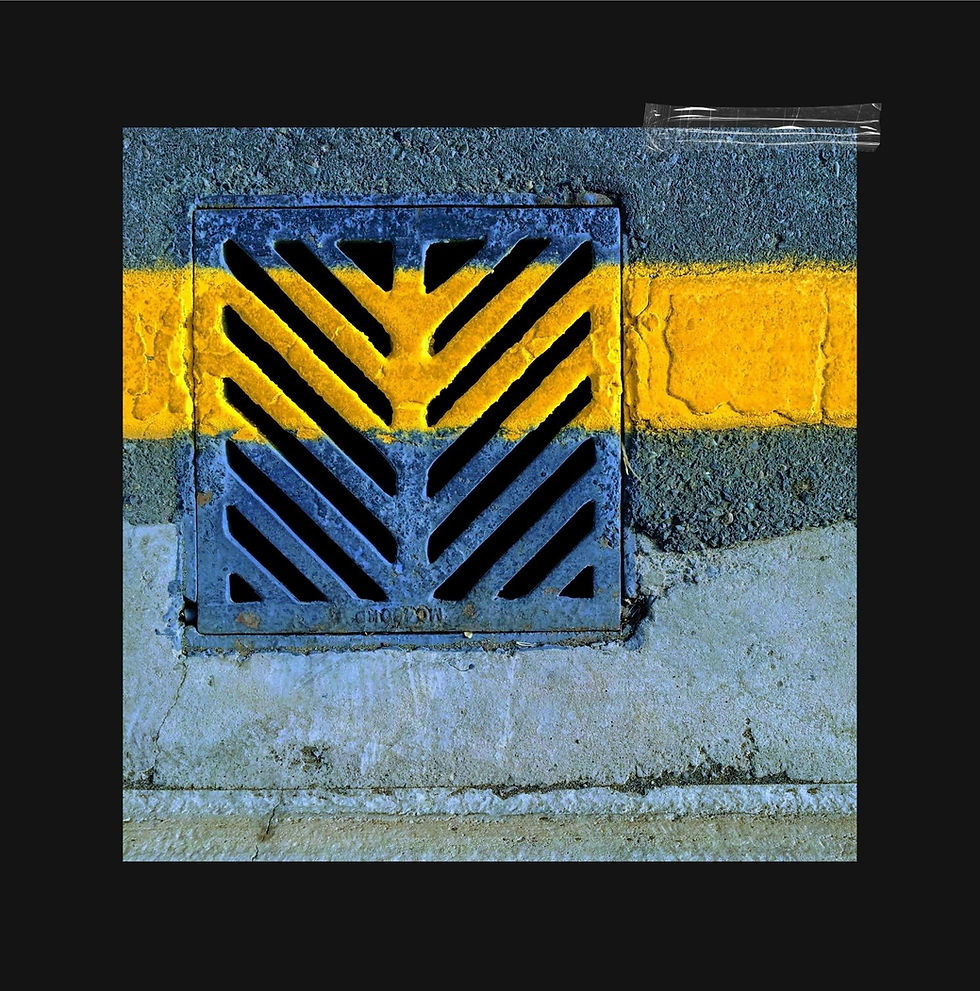
STRIPE: Urban Minimal Geometric is a book made from those moments. Every image was made on a phone camera, in the same community I had lived in for years. Transitional spaces. In-between moments. The architectural detail most people walk past without looking up. Each photograph is an invitation to stop and really see something.
The first benefit is in the intentional “seeing”. When you sit with this book and your attention is drawn into the geometry of a shadow or the way two lines intersect, you are doing what the King's College London study documented in a gallery setting. Engaging your nervous system with visual art that rewards sustained attention. Cortisol drops. The body settles. Turning a page is, quite literally, doing something measurable for your health.
Cortisol drops. The body settles. Turning a page is, quite literally, doing something measurable for your health.
The second benefit is in how it changes the way you see. Because once you start noticing the geometry in a grate, the way light falls differently at 4pm, the way two lines intersect in a car park in a way that looks composed, you cannot un-see it. That seeing becomes a practice. A daily, free, entirely portable practice that the research consistently confirms reduces stress, increases presence, and deepens your sense of meaning in the world.
You do not need to be a photographer. You do not need to make anything. You just need to look.
STRIPE is available now on Amazon. It belongs in a home where design is taken seriously, on the desk of anyone who needs a reminder that the world is more interesting than it appears on a bad day, and in the hands of anyone who wants to begin the practice of seeing differently.
The dedication reads: To seeing what is already there.
That was always the whole point.
This book is an independent artistic project and is not affiliated with, endorsed by, or sponsored by King Abdullah University of Science and Technology (KAUST)
More references if you want to learn more about art and well-being:
Dacher Keltner book https://www.penguinrandomhouse.com/books/622175/awe-by-dacher-keltner
https://ggsc.berkeley.edu/who_we_are/news/news_item/discover_awe_daily_with_oprah_and_dacher_keltner
| Longitudinal study https://www.nature.com/articles/s41598-023-35200-w
| Awe pathway paper https://pmc.ncbi.nlm.nih.gov/articles/PMC10018061/
| Journal of Health Psychology https://www.ncbi.nlm.nih.gov/pmc/articles/PMC12910538/
| Tara Swart https://www.taraswart.com/about-dr-tara-swart/
| The Signs https://www.taraswart.com/the-signs/
| STRIPE on Amazon https://a.co/d/0fBMyTxL


Comments